Threads of Japan
Thread 1
Rain, Water, Bridges
A thread is a single line of sight that runs through works of different schools and eras. Where a lineage runs vertically from master to pupil, a thread crosses it like a weft.
Hokusai painted water as force; Hiroshige painted it as weather. The difference is clearest at the one bridge they both drew: the drum bridge at Kameido Tenjin Shrine.
Rain falls, rivers run, people cross bridges. For the painters of Edo, water was not part of the scenery. It was what moved the picture. This thread sets Hokusai beside Hiroshige in three pairings, then ends with one summer shower that crossed the sea.
Pairing 1: Rain
Hiroshige's rain is visible as lines. Hokusai's rain is never drawn.
Relation: Contrast
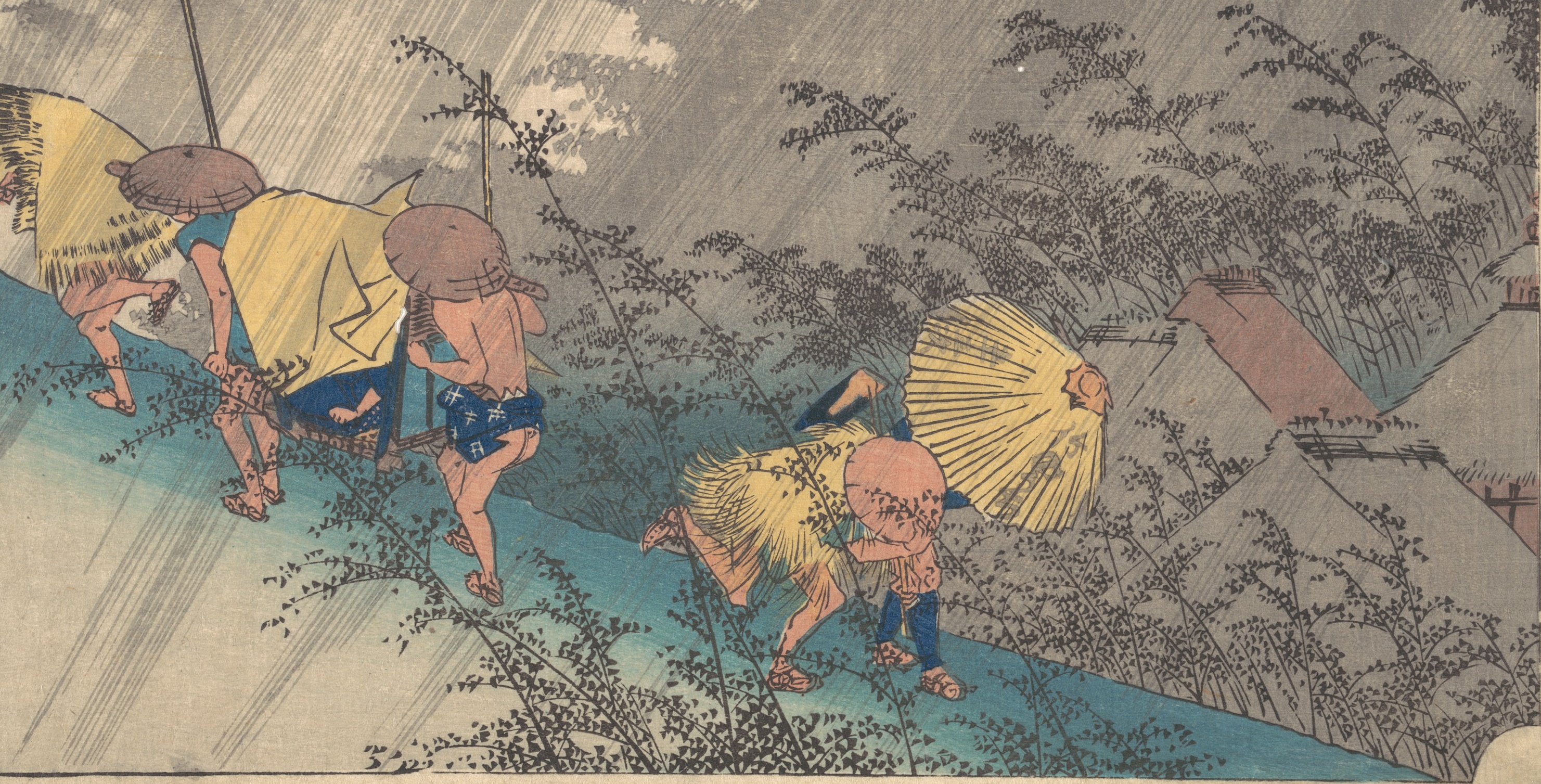
The composition
The slope's diagonal, the bamboo bent the other way by the wind, and the slant of the rain. Three diagonals collide, so a still print seems to shake. Almost no horizontal line steadies it.
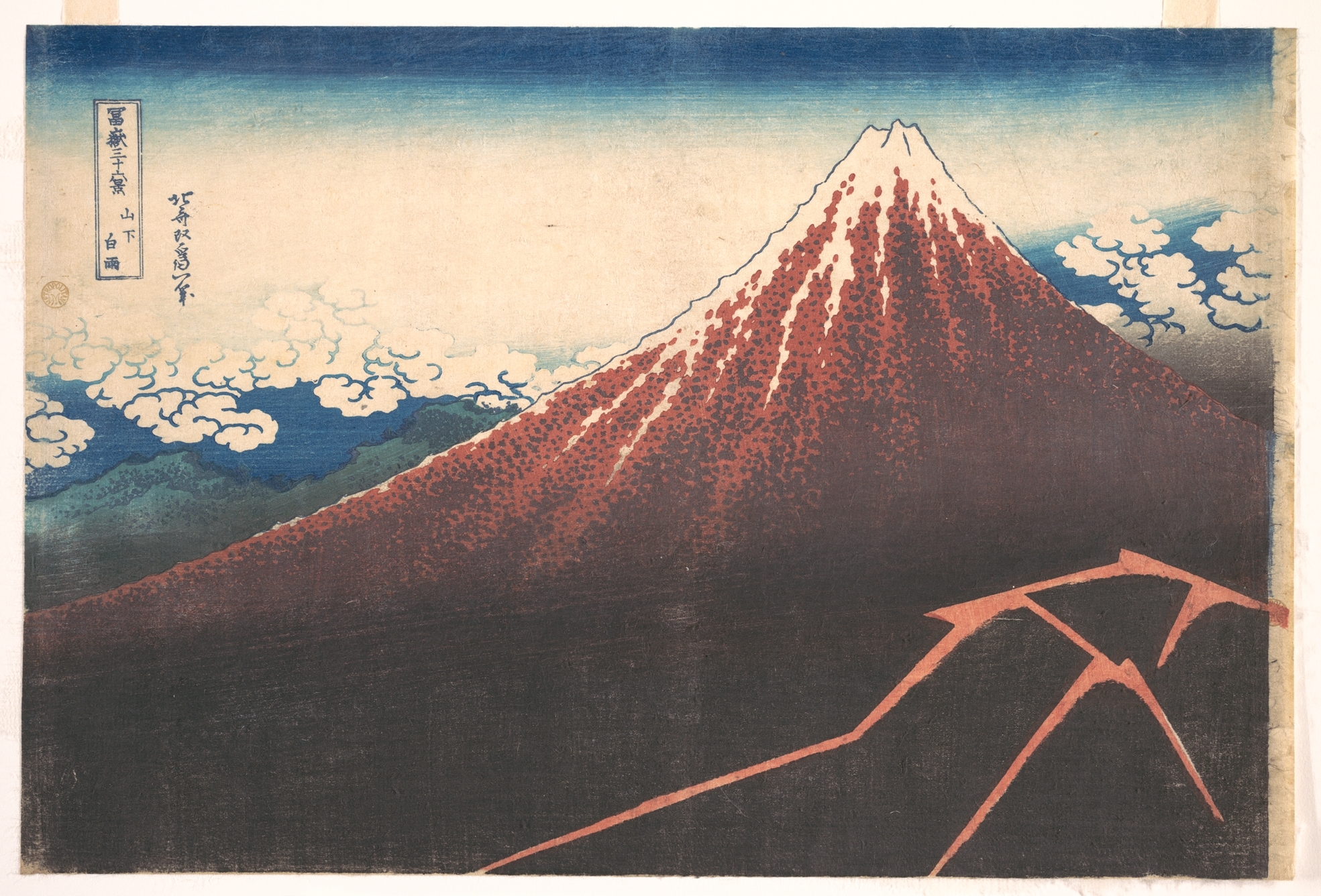
The composition
Fuji fills the sheet as one great triangle, split within itself into clear sky above and storm below. Reduced to sky and mountain, the picture lets a thin line of lightning stand out.
On the slope at Shōno, slanting lines of rain cut across the sheet as travelers run bent forward. Behind them, bamboo groves fade in layered greys. Hokusai's storm has no rain lines at all. The summit is clear, the lower slopes are dark, and lightning flickers below. The rain is not shown; it is something happening.
Look closer
Hiroshige's bamboo bending in the wind, and the lettering on a traveler's umbrella. Hokusai's lightning at the foot of the mountain.
Hiroshige paints from inside the rain. Hokusai watches it from far away.
Pairing 2: Water
Hokusai's wave is a will caught in one instant. Hiroshige's waves are a condition that goes on.
Relation: Contrast
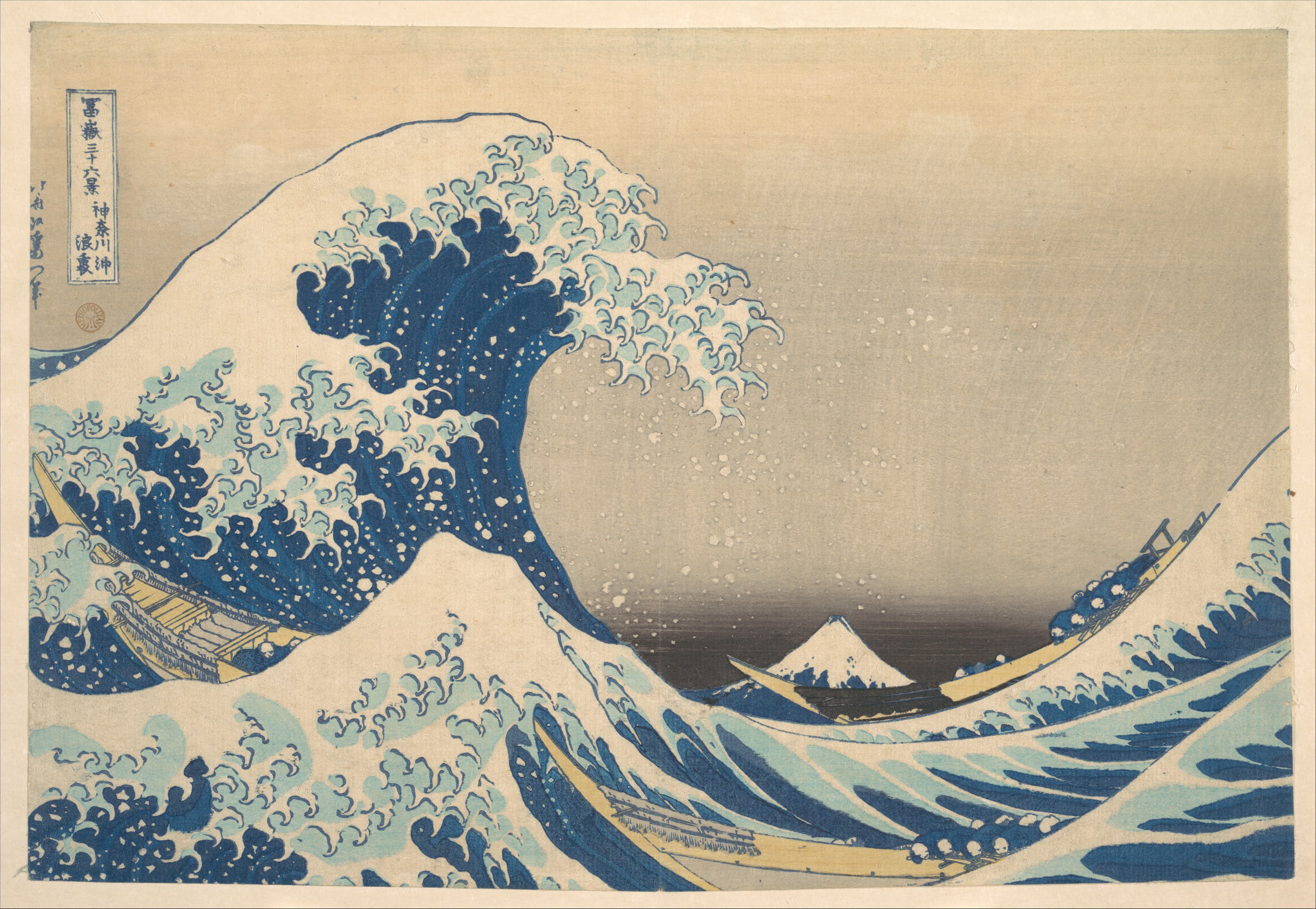
The composition
The wave's arc becomes a frame, and a small Fuji sits deep inside it. Near and far are pushed to extremes of size. A small foreground wave takes Fuji's own shape, so two mountains, one large and one small, echo each other.
Utagawa Hiroshige
Awa Province: Naruto Whirlpools, from Famous Places in the Sixty-odd Provinces
1855
Image not shown
The composition
A tall sheet, a high viewpoint, and a horizon pushed upward so the sea fills the page. With no single centre, the whirlpools let the eye drift across the whole surface, the opposite of Hokusai's focus on one point.
Hokusai stops time just before the wave breaks. Its crest splits into claws that seem to reach for the boats. Hiroshige's sea never stops. Whirlpools and whitecaps repeat across the sheet, as if to say this is how the strait looks today and tomorrow.
Look closer
The small Mount Fuji held in the trough of Hokusai's wave. The way Hiroshige draws the centre of each whirlpool.
Hokusai's sea is an event. Hiroshige's sea is a place.
Pairing 3: Bridges
At the same drum bridge, Hokusai shows the arch head-on as a shape; Hiroshige lets only part of it show through wisteria.
Relation: Same place A response across time Interpretation (a Threads of Japan reading)
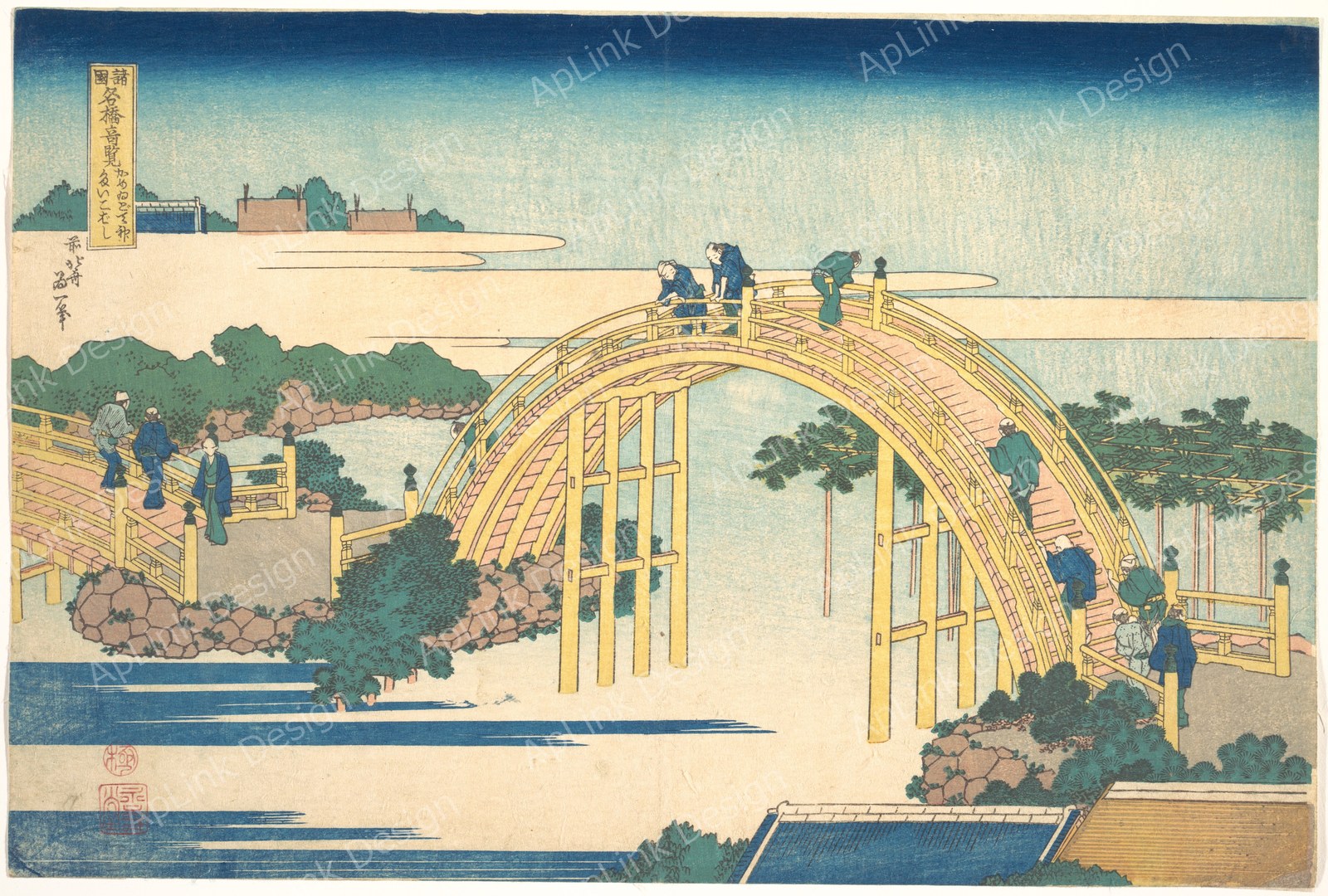
The composition
An almost geometric picture, setting the bridge's half-circle against the horizontals of trellis and water. The line of people climbing the arc carries the eye to the top.
Utagawa Hiroshige
Inside Kameido Tenjin Shrine, from One Hundred Famous Views of Edo
1856
Image not shown
The composition
A close-up foreground composition, with wisteria hanging large in front and the subject behind. The bridge is cut off at the edge and never shown whole, inviting us to imagine the shrine grounds beyond the frame.
Hokusai sets the steep half-circle at the centre, with people climbing and descending its curve. The bridge is the subject, shown as a remarkable form, as the series title promises. About twenty years later, Hiroshige hangs wisteria in the foreground and lets the bridge appear behind it. The bridge gives up the lead role and melts into spring weather and still water.
Look closer
The number and poses of Hokusai's figures on the bridge. The fine wisteria clusters and the reflections in Hiroshige's water.
Hokusai makes you cross the bridge. Hiroshige makes you look at it.
Coda: The Shower That Crossed the Sea
Relation: Copy
Vincent van Gogh
Bridge in the Rain (after Hiroshige)
1887
Image not shown
Composition and Van Gogh
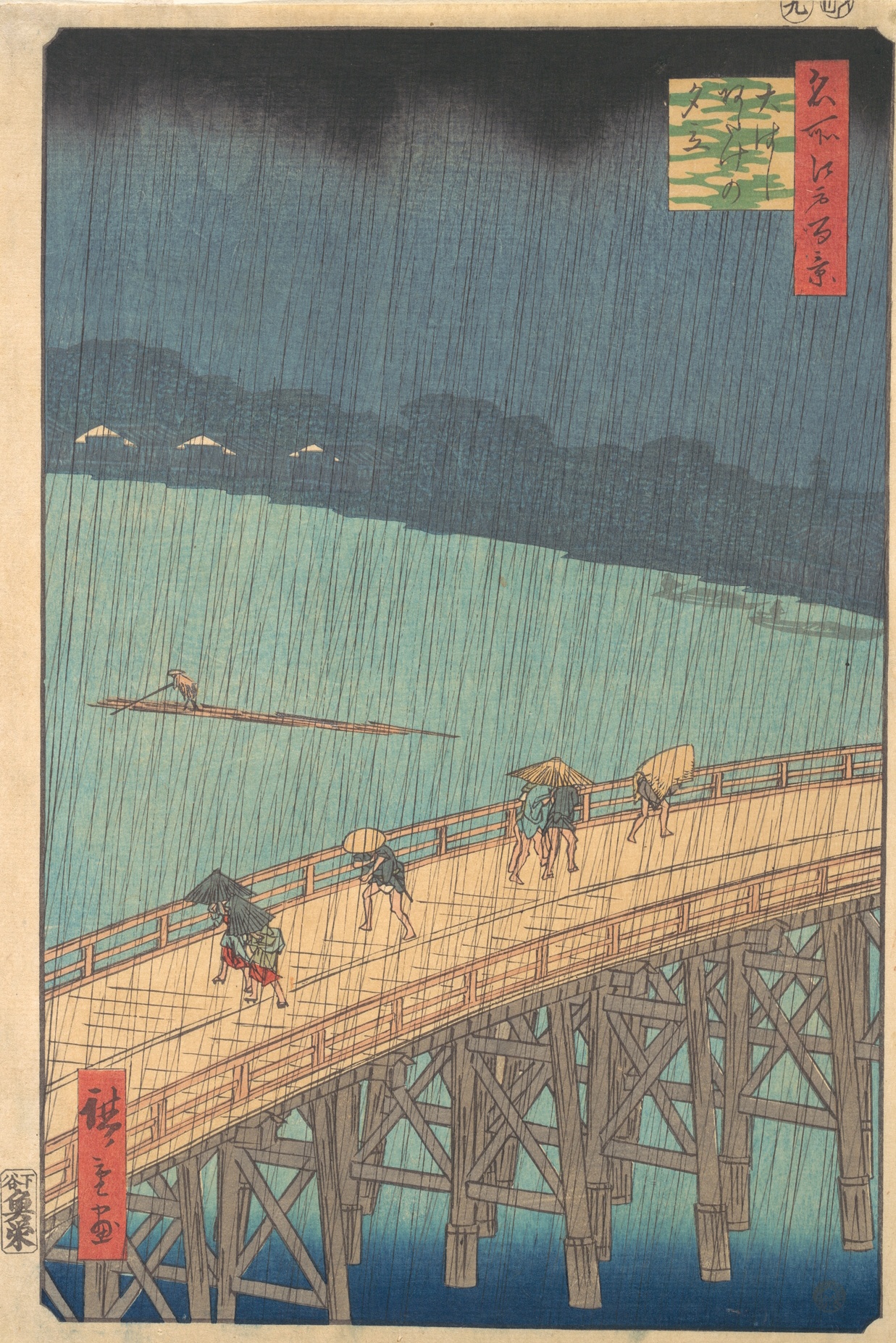
Utagawa Hiroshige, Sudden Shower over Shin-Ōhashi Bridge and Atake, from One Hundred Famous Views of Edo
The bridge crosses the sheet on a diagonal, the far shore dissolves in rain, and a dark band of cloud is graded along the top. The slanting bridge and the near-vertical rain form a mesh that holds the people on the bridge.
Vincent van Gogh, Bridge in the Rain (after Hiroshige)
He kept the composition almost exactly, adding a frame-like border of Japanese characters. He replaced the flat colour of the print with stronger colour and oil brushwork. Colour and medium changed; the skeleton of diagonal bridge and rain lines did not.
Thirty years after this print of rain over a bridge, Van Gogh copied it in oil in Paris. An Edo summer shower changed how a Western painter saw. Western praise, in turn, led Japan to look again at ukiyo-e as art. What is seen changes the one who sees, and that changes how it is seen next.